Publication

Cover imageNotre  premier papier sur les applications de la LIBS en géologie est en ligne dans la revue Spectrochimica Acta Part B: Atomic Spectroscopy

Testing a portable Laser-induced Breakdown Spectroscopy system on geological samples

Jozef Rakovskýab , Olivier Musseta, JeanFrançois Buoncristianic, Vincent Bichetd, Fabrice Monnae, Pascal Neigec, Pavel Veisbf`

  • a Laboratoire interdisciplinaire Carnot de Bourgogne, UMR 6303 CNRS – Université de Bourgogne, 9 Av. A. Savary, BP 47 870, F −21078 DIJON Cedex, France
  • b Department of Experimental Physics FMFI, Comenius University, Mlynská dolina, 842 48 Bratislava, Slovakia
  • c Laboratoire Biogéosciences, UMR CNRS 6282 – Université de Bourgogne, 6 Boulevard Gabriel 21000 Dijon, France
  • d Laboratoire Chrono-Environnement, UMR CNRS 6249 – Université de Besançon, 16 Route de Gray 25000 Besançon, France
  • e Laboratoire ARTéHIS, UMR CNRS 6298 – Université de Bourgogne, 6 Boulevard Gabriel 21000 Dijon, France
  • f State Geological Institute of Dionýz Štúr, Mlynská dolina 1, 817 04 Bratislava 11, Slovakia
     

    Abstract

This paper illustrates the potentialities of a home-made portable LIBS (Laser-Induced Breakdown Spectroscopy) instrument in Earth sciences, more particularly in geochemically recognizing (i) tephra layers in lacustrine sediments and (ii) fossilization processes in ammonites. Abundances for selected lines of Al, Ca, Fe, Ti, Ba and Na were determined in lacustrine chalk sediments of the Jura, where the Laacher See Tephra (LST) layer is recorded. A statistical treatment of elemental maps produced from the section of a sedimentary column containing the LST event allows instrumental conditions to be optimized. Accumulating spectra from close shot positions gives better results than multiplying shots at the same location. A depth profile method was applied to study ammonite fossilization (pyritization, phosphatization) processes. Depth variations of Fe, Ca, Al intensities, and Fe/Ca and Al/Ca ratios provide indications about pyritization, but phosphatization processes cannot be determined with our device.
Mission Islande Juin 2012

Nous venons d’effectuer en Islande une mission qui a permis d’évaluer les capacités d’un nouveau prototype de spectroscopie laser portable (LIBS) développé à l’Institut Carnot de Bourgogne. Cette mission a mis en évidence  la robustesse de ce nouveau laser dans des conditions réelles de terrain ainsi que sa capacité à déterminer les différents types de roches volcaniques in situ.

Ce travail résulte d’un projet interdisciplinaire soutenu en 2012 par l’Université de Bourgogne (BQR 2012) et regroupant différents spécialistes issus de 4 laboratoires (Institut Carnot de Bourgogne, Biogéosciences, Arthésis et Chrono-Environnements).

Ce diaporama nécessite JavaScript.

Une vidéo de cette mission est disponible ici (F. Monna)

Sortie Terrain 2012 – Licence 3 sciences de la terre et environnement – Géotraverse

Ecole de terrain Bourgogne, Jura  et Alpes (région de Chamonix) et illustrant les grands domaines de la géologie enseignée au cours de la 3 année de Licence.

Ce diaporama nécessite JavaScript.

Mission Franceville – Gabon

En collaboration avec l’Université de Franceville et AREVA, une mission a été réalisée dans le Bassin de Franceville afin d’étudier les environnements sédimentaires de dépôts précambrien (datés d’environs 2 GA).

Ce diaporama nécessite JavaScript.

Sortie Terrain 2012 – Licence 3 sciences de la terre et environnement

Dans le cadre de l’option Environnements sédimentaires,  sortie sur le terrain dans le Jura afin d’étudier les dépôts et les structures caractéristiques d’un environnement glaciaire (exemples issus des affleurements du pleni-glaciaire supérieur) .

Ce diaporama nécessite JavaScript.

Récupération des données post-hivernales

Début mars, la récupération des données du data-logger de la station des Bossons a pu être effectuée correctement. Après un hivernage de 5 mois (Octobre 2011 à Mars 2012) dans des conditions extrêmes, il fonctionne parfaitement.

Ce diaporama nécessite JavaScript.

Publication

Le 08/01/2012

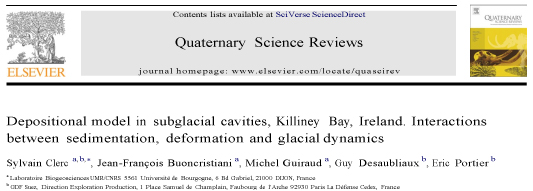
Sortie d’un article sur les modèles de dépôts dans les cavités sous-glaciaires d’Irlande.

Abstract :
Subglacial meltwater drainage and sedimentary processes play a major role in ice-sheet dynamic but there is a lack of study of subglacial environment because modern ice-sheet beds remain inaccessible. Previous authors already intended to provide diagnostic criterion and recent investigations suggest that fluid pressure variations are a key factor in subglacial environment. This paper investigated the late Devensian sedimentary record in order to describe subglacial sedimentological facies associations and deformation features related to fluid overpressures. We used an integrated approach, based on stratigraphy, sedimentology and deformations styles to demonstrate a subglacial depositional model. The studied interval is composed of stratified gravel and sand interbedded with diamicton and boulder pavement, deposited in depressions formed by irregularity of the upper surface of diamicton. Deformation structures include convolutes, dykes and normal micro-faulting. Dykes show different dip directions from vertical, oblique to subhorizontal from which both directions of shortening and extension can be determined. Vertical dykes are formed under pure shear strain related to ice weight only. Oblique dykes imply both ice-bed coupling and simple shear strain between ice and substrate induced by flowing ice related to progressively increasing meltwater drainage intensity. Horizontal dykes are formed when minimum strain is vertical and therefore the overpressure exceeds the weight of overburden. They are associated with high meltwater drainage intensity and ice-bed uncoupling and refer to hydrofracturing. Overall, depositional and deformation sequence also illustrates the increasing intensity of meltwater drainage in small cavity as high energy channelised deposits, and in large cavities where subaqueous fan are deposited under hydraulic jump conditions. Moreover, large cavities represent lee-side cavities formed by fast-flowing ice over an obstacle. Hydrofracturing is likely to occur when a dense fluid, potentially associated with catastrophic drainage of an upstream cavity enters the low-pressure confined environment of a downstream cavity and is injected under pressure in the soft substrate. The studied glacial sequence represents a regional pattern probably related to an allocyclic control on sedimentation linked to long-term glacial dynamics rather than local depositional conditions. Based on these results, we provided a synthetic model linking depositional and deformation processes during ice-sheet growth and decay, but also valid at different timescales from annual to seasonal scale.

Mission Maroc – Décembre 2011

Mission dans l’Anti-Atlas marocain sur les dépôts glaciaires Ordoviciens permettant la reconnaissance et l’échantillonnage des structures de déformations sous-glaciaires.

Ce diaporama nécessite JavaScript.

Carottage du lac du Val (Jura)

Carottage sur les rives du lac du Val (Jura) permettant  de trouver le niveau de cendre correspondant à l’éruption du volcan Laacher See (Allemagne) et daté entre -12 900 et -11 200 ans, afin de tester son  analyse chimique atomique directement sur le terrain en utilisant un système portable de LIBS (Laser-induced breakdown spectroscopy).

Ce diaporama nécessite JavaScript.

Projet en collaboration avec L’ ICB Carnot (Dijon) et Chrono-Environnement (Besançon).