Revue de Presse : Le mont blanc prend de l’altitude

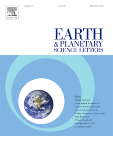
Revue de presse des articles publiés dans différents médias internationaux suite à la publication de notre article : The Bossons glacier protects Europe’s summit from erosion, dans la revue EPSL.

nature_logo

blq-blocks_grey_alpha

actualite-news-environnement

rai

logo

BP

INSU

JSL

the conservation

Sans titre

Sans titre

logo

2286545015

EJU.tv

logo-tech

El Comercio Peru

logo india

logo

logo ps

Interviews pour Nature News : Mont Blanc growing with help from glaciers

Nature News publie un article suite à une interview portant sur nos travaux réalisés sur le relief du massif du mont-Blanc qui viennent d’être publiés dans EPSL

Olive Heffernan. 2013. Mont Blanc growing with help from glaciers Nature doi:10.1038/nature.2013.13357

nature view comment on EPSL

Ref  : Godon, C. et al. Earth Planet. Sci. Lett. http://dx.doi.org/10.1016/j.epsl.2013.05.018 (2013).

Publication :

S0012821X

Sortie du papier sur l’étude du relief du mont-blanc : Godon C., Mugnier JL., Fallourd R., Paquette JL., Pohl A., et Buoncristiani JF.2013. The Bossons glacier protects Europe’s summit from erosion. Earth and Planetary Science Letters, in press

Cet article est en ligne 

Highlights

  • Nous déterminons l’efficacité de l’érosion dans un bassin versant glaciaire.
  • Source des sédiments est déduite sur de critères macroscopiques et sur des datations U-Pb sur zircons.
  • Le transport glaciaire ne se mélange  les sédiments  supraglaciaire et sous-glaciaires.
  • L’érosion sous-glaciaire est inférieure à l’érosion dans les zones non glaciaires.
  • Il n’y a pas d’érosion sous glace froide, les glaciers de protéger donc le relief.
  • We determine the erosion efficiency in a glaciated watershed.
  • Sediment source is inferred from macroscopic criteria and U–Pb dating on zircons.
  • The glacial transport does not mix the supraglacial and the subglacial sediments.
  • The subglacial erosion is lower than the erosion in the non-glaciated areas around.
  • There is no erosion beneath cold ice meaning that the glaciers protect the relief

sortie L3 2013-13

Publication :

Notre dernier papier sur la glaciation Ordovicien est en ligne

Subglacial to proglacial depositional environments in an Ordovician glacial tunnel valley, Alnif, Morocco

  • a Laboratoire Biogeosciences UMR/CNRS 6282 Université de Bourgogne, 6 Bd Gabriel, 21000 DIJON, France
  • b GDF Suez EPI, 1 place Samuel de Champlain – Faubourg de l’Arche 92930 Paris La Défense Cedex – France

Abstract

This paper presents the sedimentary analysis of an exceptional Ordovician glacial tunnel valley in the eastern part of the Anti-Atlas. The valley infill comprises two major glacial erosion surfaces (striated pavements) each overlain by a fining-upward glacial unit. These units are composed of five distinct facies associations, recording the evolution from subglacial to proglacial environments, and an additional sixth facies association, overtopping the tunnel valley infill, and associated with post-glacial environments. The tunnel valley infill also records a transitional environment between the subglacial and proglacial settings, which is compared with the Antarctic ice-sheet margin. These three environments are defined by the position of the grounding line and the coupling line. The new proposed depositional model also differs from usual Ordovician depositional models in which the main tunnel valley infill is interpreted as essentially proglacial outwash deposits, in a range of glaciomarine to glaciofluvial environments. Overall, a substantial part of the valley infill (~ 50% of volume) was deposited in a subglacial setting. The sedimentary bodies could form potentially thick and laterally extended, although these were limited by the shape and extent of the subglacial accommodation space. Finally, the sedimentary record, when compared with regional analogues, also provides information for the palaeogeographic reconstruction of the Ordovician ice-sheet in this region.


Highlights

► An Ordovician tunnel valley infill is described in detail ► Subglacial and proglacial depositional environments are determined ► An additional environment is proposed associated with a lightly grounded ice-sheet ► Accommodation space is defined for proglacial and subglacial settings ► The study provides additional data for Hirnantian ice-sheet reconstruction

Publication

Cover imageNotre  premier papier sur les applications de la LIBS en géologie est en ligne dans la revue Spectrochimica Acta Part B: Atomic Spectroscopy

Testing a portable Laser-induced Breakdown Spectroscopy system on geological samples

Jozef Rakovskýab , Olivier Musseta, JeanFrançois Buoncristianic, Vincent Bichetd, Fabrice Monnae, Pascal Neigec, Pavel Veisbf`

  • a Laboratoire interdisciplinaire Carnot de Bourgogne, UMR 6303 CNRS – Université de Bourgogne, 9 Av. A. Savary, BP 47 870, F −21078 DIJON Cedex, France
  • b Department of Experimental Physics FMFI, Comenius University, Mlynská dolina, 842 48 Bratislava, Slovakia
  • c Laboratoire Biogéosciences, UMR CNRS 6282 – Université de Bourgogne, 6 Boulevard Gabriel 21000 Dijon, France
  • d Laboratoire Chrono-Environnement, UMR CNRS 6249 – Université de Besançon, 16 Route de Gray 25000 Besançon, France
  • e Laboratoire ARTéHIS, UMR CNRS 6298 – Université de Bourgogne, 6 Boulevard Gabriel 21000 Dijon, France
  • f State Geological Institute of Dionýz Štúr, Mlynská dolina 1, 817 04 Bratislava 11, Slovakia
     

    Abstract

This paper illustrates the potentialities of a home-made portable LIBS (Laser-Induced Breakdown Spectroscopy) instrument in Earth sciences, more particularly in geochemically recognizing (i) tephra layers in lacustrine sediments and (ii) fossilization processes in ammonites. Abundances for selected lines of Al, Ca, Fe, Ti, Ba and Na were determined in lacustrine chalk sediments of the Jura, where the Laacher See Tephra (LST) layer is recorded. A statistical treatment of elemental maps produced from the section of a sedimentary column containing the LST event allows instrumental conditions to be optimized. Accumulating spectra from close shot positions gives better results than multiplying shots at the same location. A depth profile method was applied to study ammonite fossilization (pyritization, phosphatization) processes. Depth variations of Fe, Ca, Al intensities, and Fe/Ca and Al/Ca ratios provide indications about pyritization, but phosphatization processes cannot be determined with our device.

Publication

Le 08/01/2012

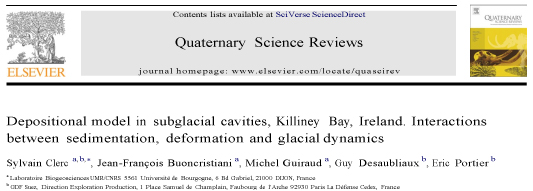
Sortie d’un article sur les modèles de dépôts dans les cavités sous-glaciaires d’Irlande.

Abstract :
Subglacial meltwater drainage and sedimentary processes play a major role in ice-sheet dynamic but there is a lack of study of subglacial environment because modern ice-sheet beds remain inaccessible. Previous authors already intended to provide diagnostic criterion and recent investigations suggest that fluid pressure variations are a key factor in subglacial environment. This paper investigated the late Devensian sedimentary record in order to describe subglacial sedimentological facies associations and deformation features related to fluid overpressures. We used an integrated approach, based on stratigraphy, sedimentology and deformations styles to demonstrate a subglacial depositional model. The studied interval is composed of stratified gravel and sand interbedded with diamicton and boulder pavement, deposited in depressions formed by irregularity of the upper surface of diamicton. Deformation structures include convolutes, dykes and normal micro-faulting. Dykes show different dip directions from vertical, oblique to subhorizontal from which both directions of shortening and extension can be determined. Vertical dykes are formed under pure shear strain related to ice weight only. Oblique dykes imply both ice-bed coupling and simple shear strain between ice and substrate induced by flowing ice related to progressively increasing meltwater drainage intensity. Horizontal dykes are formed when minimum strain is vertical and therefore the overpressure exceeds the weight of overburden. They are associated with high meltwater drainage intensity and ice-bed uncoupling and refer to hydrofracturing. Overall, depositional and deformation sequence also illustrates the increasing intensity of meltwater drainage in small cavity as high energy channelised deposits, and in large cavities where subaqueous fan are deposited under hydraulic jump conditions. Moreover, large cavities represent lee-side cavities formed by fast-flowing ice over an obstacle. Hydrofracturing is likely to occur when a dense fluid, potentially associated with catastrophic drainage of an upstream cavity enters the low-pressure confined environment of a downstream cavity and is injected under pressure in the soft substrate. The studied glacial sequence represents a regional pattern probably related to an allocyclic control on sedimentation linked to long-term glacial dynamics rather than local depositional conditions. Based on these results, we provided a synthetic model linking depositional and deformation processes during ice-sheet growth and decay, but also valid at different timescales from annual to seasonal scale.

Publication

Le 05/08/2011

Sortie d’un article sur les grandes extensions glaciaires dans les Alpes et le Jura.

Buoncristiani JF and Campy M. Quaternary Glaciations in the French Alps and Jura. In J. Ehlers, P.L. Gibbard and P.D. Hughes, editors: Developments in Quaternary Science, Vol. 15, Amsterdam, The Netherlands, 2011, pp. 117-126.

Abstract : During last glacial maximum, the pre-existing relief of the Alps and the Jura mountains controlled glacier development. The Jura massive morphology, only slightly dissected by valleys, resulted in a wide ice-sheet; and this situation contrasts with the Alps where numerous deep valleys were filled by big glaciers.

Key word : Alps, Jura, Ice sheet, valley glacier, relief

Developments in Quaternary Science, Vol. 15